What we can learn from three decades of booms and busts
Burning Up. That was the title of the now infamous Barron’s article published on 20th March 2000 that accelerated the deflation of the dotcom bubble. The Nasdaq Composite Index had made an all-time high 10 days prior, breaching 5,000 points for the first time, and investors assumed the fall in prices was a buying opportunity. That is, until the article exposed many of the leading internet companies were mere months away from running out of cash.
Similarly, on 31st October 2007 Meridith Whitney, a financial analyst at Oppenheimer and Co. published a devastatingly accurate report calling out the exposures of banks like Citigroup to the subprime mortgage market. The news wiped $390bn off the US stock market in a single day, marking the top of the cycle, and the downfall was spectacularly told in Michael Lewis’ book The Big Short.
What can we learn from these events? Other than the power of the written word, or the dangers of unsustainable borrowing and capital expenditure, they share one main commonality: denial. For years investors, CEOs, ratings agencies, and regulators all refused to acknowledge and properly account for the risks. The adage ‘history doesn’t repeat itself, but it often rhymes’ comes to mind. Today the story has echoes of the past.
Performance vs. profitability: are AI stocks overvalued?
Since the launch of ChatGPT in November 2022, the Nasdaq 100 has risen 114% on a total return basis. To put this into context, during the dotcom bubble, widely considered to be between August 1995 and March 2000, it rose 720%. Even if we focus solely on semiconductor companies today, their rise of 208% pales in comparison to the velocity of the hype in 2000. Furthermore, a key difference this time is the companies are largely profitable. The recent pullback in tech stocks puts the Nasdaq 100 on a forward Price to Earnings (P/E) ratio of 18x. The last time tech stocks were this cheap was during the Covid-19 pandemic. In the first eight months of 2026, Amazon, Alphabet, Oracle, Meta and Microsoft have issued over $155bn in debt in a bid to fuel further AI development. The big question is whether all of this capital expenditure can generate the technological and promised productivity advancements that will reap rewards in future.
Corporate finance: what is different about AI companies coming to market?
There was a flurry of initial public offerings (IPOs) in the late 90s as hundreds of unprofitable internet companies came to market. While the IPO market is currently seeing plenty of activity, including SpaceX’s record $75bn IPO in June and Anthropic’s much anticipated debut in November, we don’t have the same number of listings. Companies are staying private for longer and the bulk of AI development is concentrated in the hyperscalers. Furthermore, not every company that went public in the dotcom bubble went bust. A famous survivor was Amazon. There will almost certainly be losers among today’s AI companies, but there may also be opportunities for cash-rich companies such as Apple, which is widely seen as behind in AI, to acquire struggling start-ups at lower prices and close the gap.
Monetary and fiscal policy: how interest rates can fuel a bubble
In 1998 US capital gains tax cuts fuelled the boom by making the stock market more attractive, meanwhile the Fed cut rates to calm markets after the Asian crisis, Russia’s default and the collapse of a major hedge fund. Cheap money flooded the market, extending the dotcom rally. By late 1999 rapid growth and rising oil prices were causing inflation to run hot, and the Fed resorted to rising rates six times. In 2024/5 the Fed embarked on a similar cutting cycle, for different reasons, and the Trump administration’s One Big Beautiful Bill Act approved tax cuts and rebates similarly fuelling markets. The recent conflict with Iran has increased inflationary pressures that have resulted in rate hikes in the US, Europe and UK making it difficult for AI companies to continue raising cheap debt.
Accounting practices: are company profits telling the whole story?
An accusation across both crises was the use of untransparent accounting practices which allowed companies to shield their true financial positions from investors. Post 2000, Worldcom was found to be inflating its assets while in 2008 Enron used off-balance sheet vehicles to conceal debt. In 2002 the US passed the Sarbanes-Oxley Act to protect investors from corporate accounting fraud yet today companies face similar accusations of creative accounting. Last year Meta completed a $30bn deal to build a data centre in Louisiana; the off-balance sheet financing means this debt is not reflected in the company’s credit rating. Meanwhile the hyperscalers, who are at the centre of a closed loop of circular AI investment, are lifting reported earnings through investment markups. Seventy percent of Amazon and Alphabet’s reported earnings in Q2 2026 were driven by such markups.
There is also no consensus on the lifecycle of a Graphics Processing Unit (GPU). The hyperscalers are depreciating microchips over six years. Experts suggest they could be burned through in three years due to stress and excessive heat, whereas others say they can last nine. Underestimating depreciation expenses and extending the years of useful life could be artificially enhancing current profits if this later proves to be inaccurate.
Regulation: could government intervention change the investment outlook?
In September 1998, a hedge fund called Long-Term Capital Management folded, and the Fed arranged a consortium of banks to bail it out. Two years later, in April 2000, Microsoft was found to have broken antitrust law, and while not related to the internet boom, it signalled to investors that these companies were not invincible and marked a key change in sentiment. Since the Global Financial Crisis (GFC) we have only had three months of recession (due to Covid) in 17 years, even the 2023 Silicon Valley Bank disruption was minimal. It raises the question; would the Fed come to the rescue of failing AI companies?
Today, regulators are clamping down on AI companies. The recent US midterm elections were a sweeping victory for the US Democratic party who campaigned on reducing data centre construction. They have proposed legislation that would prevent the bail out of failing tech companies and force executives to be held accountable under civil and criminal law. However, President Trump retains the power to veto such changes and his recent support for Jensen Huang’s reinstatement as Nvidia’s CEO suggests poor corporate governance has made one man and one company too big to fail, even at the expense of US national security. While legal investigations will continue for some time, without consequences the AI elite could be emboldened to act with impunity.
Market dynamics: what is causing extreme market moves?
Markets have changed considerably in the last three decades. Equity markets are 2.8x larger than they were in 2007/08 and debt markets are 2.3x larger, yet global ETF assets have grown 30x. Markets are more complex and react faster than ever before thanks to the use of algorithmic, high frequency trading, leveraged products and short selling. An order that took 350 milliseconds in 2007 now takes 5 milliseconds, 70x faster. While it means faster pricing, it doesn’t mean more accuracy. The launch of leveraged single stock ETFs in South Korea this year caused a retail frenzy in the KOSPI index followed by a violent unwind, with many leveraged ETFs losing 70-90% of their value in weeks.
Denial: being aware of the warning signs
Today, we don’t have the same level of denial. Talk of an AI bubble have been rife for the past two years. Michael Burry, the fund manager who famously made millions in the GFC by correctly betting against the subprime mortgage market, has been publicly betting against AI companies since Q1 2025. Andrew Bailey, the Governor of the Bank of England, has been warning about the risk of contagion from an AI bubble for the last twelve months. Bubbles rarely burst when everyone is talking about them. More commonly, it’s when investors become complacent and assume every dip is a buying opportunity. The Nasdaq Composite Index experienced seven corrections of more than 10% before peaking in 2000. That reminds us of another famous quote: ‘Markets can remain irrational longer than you can remain solvent’.
We are not in the business of trying to time the market or speculate who the winners or losers of the AI race will be, even the CEOs themselves don’t know that. Instead, we will be guided by our traffic light investment process to judge if and when the time comes to reduce risk in our portfolios.
Is all hope lost?
In short, no. Previous cycles of booms and busts have not been universally bad news. The AI trade is fuelling stock market performance in the US, China, Korea, Taiwan, and Japan but less so in countries and regions like the UK, Europe, Brazil, Canada, India and Australia which have less exposure to technology and more to defensive sectors. In times of stress, when equities and corporate bonds can be correlated, we also look to other asset classes like alternatives, cash, commodities, and government bonds.
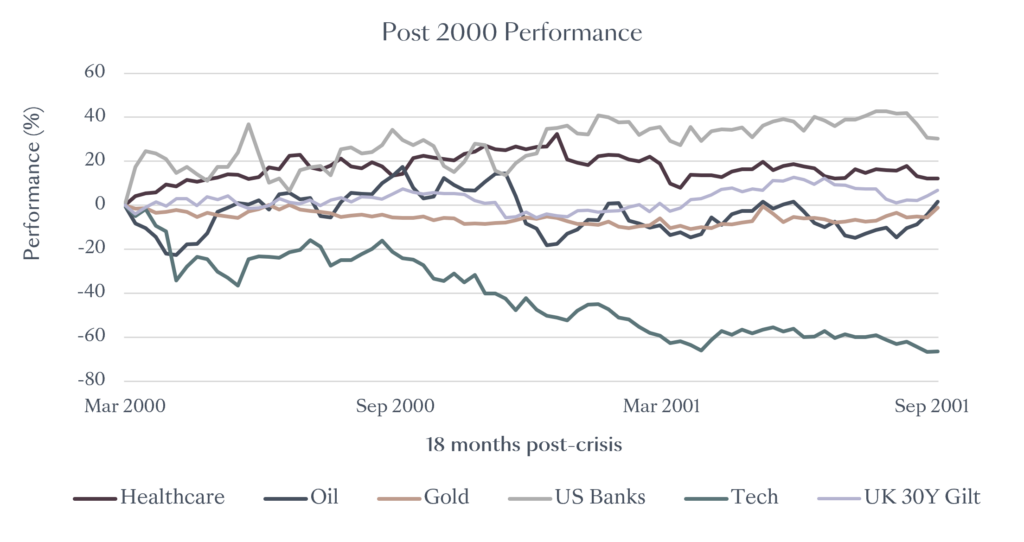
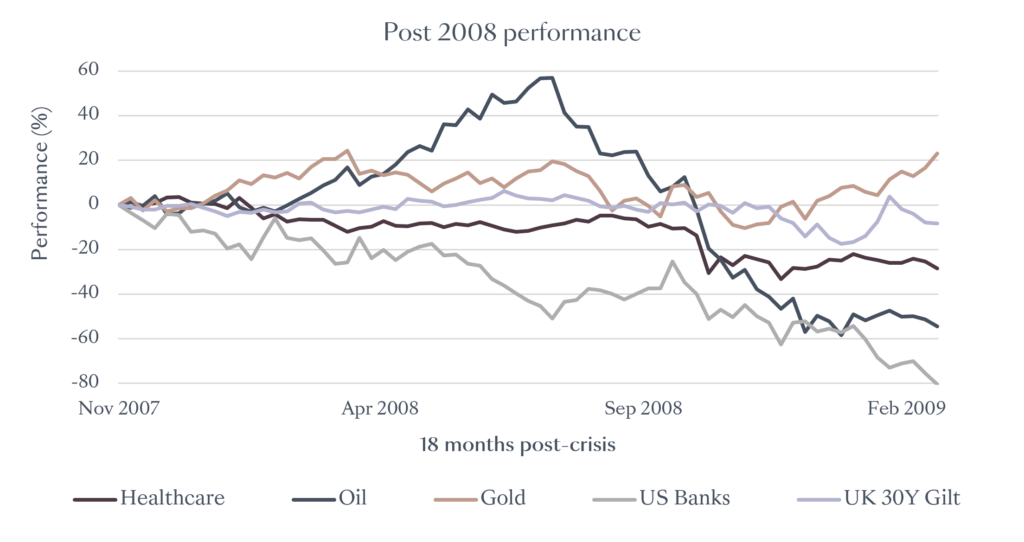
When the internet bubble burst in 2000 there were years of sell offs and failed rallies. During this time banks were up over 40% and healthcare nearly 30%. Similarly, in the 2008 financial crash oil and gold initially rose nearly 60% and 20%, respectively.
This is why building a diversified portfolio of different asset classes, regions and sectors has a proven track record of balancing risk and return. That doesn’t mean we can predict a peak in markets, but it does mean performance is not dependant on the fate of one company, sector or country. We have an abundance mindset. There will always be opportunities, and we will be particularly reliant on our Momentum and Sentiment traffic lights, to tell us when and where opportunities arise.
Conclusion
It’s rarely one isolated incident that topples a market. More commonly it’s a combination of pressures spread across a web of investment with too many companies and policy makers operating in silos. Share prices of technology companies are undoubtedly high, only time will tell whether they are fair. While there are eerie similarities to previous booms, the rate of change in share prices, listings, or rate hikes is not the same. Markets are however larger, faster and more volatile than ever before.
Who knows, maybe all it takes is one analyst with novel research willing to go against the grain and perhaps something as innocuous as an article could cause a discernible shift in investor sentiment in the months to come. Maybe that analyst could even be an AI agent, now that would be a good story. We’ll only know the catalyst with the power of hindsight. As with The Big Short, that story will be better told by Michael Lewis. In the meantime, we are reminded that correlation does not equal causation. They do kind of rhyme though.