With the US midterm elections looming, the UK autumn budget due and broader geopolitical tensions competing for headlines, it is natural for political risk to be at the forefront of investors’ minds.
We are often asked whether our traffic light investment process has a signal for politics. In short, the answer is no. The majority of political events do not have long-term impacts on investment markets. The political climate is constantly shifting; governments change and policies alter – yet global stock markets, viewed over long periods, have historically tended to carry on regardless.
Looking at some of the most turbulent political moments in recent memory: Brexit, the US-China trade war, leadership changes and fragile coalitions in Europe, and repeated crises in the Middle East; in each case, markets wobbled briefly before recovering and moving on (1). The reason for this is straightforward: what ultimately drives the value of companies, and therefore their share prices, is their ability to generate profits over the long term. Political noise, however loud, only affects that underlying reality in a limited number of circumstances. For example, changes to corporate taxes or tariffs may derail some profits in the short term, but companies typically adapt and it is not long before the impacts are either absorbed, avoided or passed on to the consumer. However, there can be exceptions, such as in more politically unstable developing nations where the impact of regime change is felt more keenly through their stock markets.
Our traffic light process monitors signals through four lenses: economic growth dynamics (Growth), availability and cost of credit through interest rates (Money), trends in investment markets (Momentum) and investor mood (Sentiment). This means that political risk, when it is meaningful, does not go unnoticed. It simply tends to manifest through one or more of our traffic lights.
When geopolitical tensions flare, the impact tends to show up first as short-term swings in investor sentiment. A signal of extreme optimism in our Sentiment traffic light can often precede a selloff in markets, while an overly pessimistic response to an alarming headline can present a buying opportunity. While sentiment is important, it would need to be accompanied by a genuine shift in the wider economic backdrop for politics to be a driving force in stock markets.
US midterm elections
The United States midterm elections are fast approaching. All seats in the House of Representatives and a third of the Senate are contested. The Democrats could win control of both chambers, which would limit the President’s ability to pass legislation and significantly reshape the political landscape in Washington.
Historically markets have favoured political gridlock; when a divided House and Senate make it difficult to roll out new legislation, companies can get on with making money. Regardless of the outcome, the President retains the power to enforce change by Executive Order – a tool used frequently by Donald Trump – bypassing the need for approval from the House and the Senate altogether.
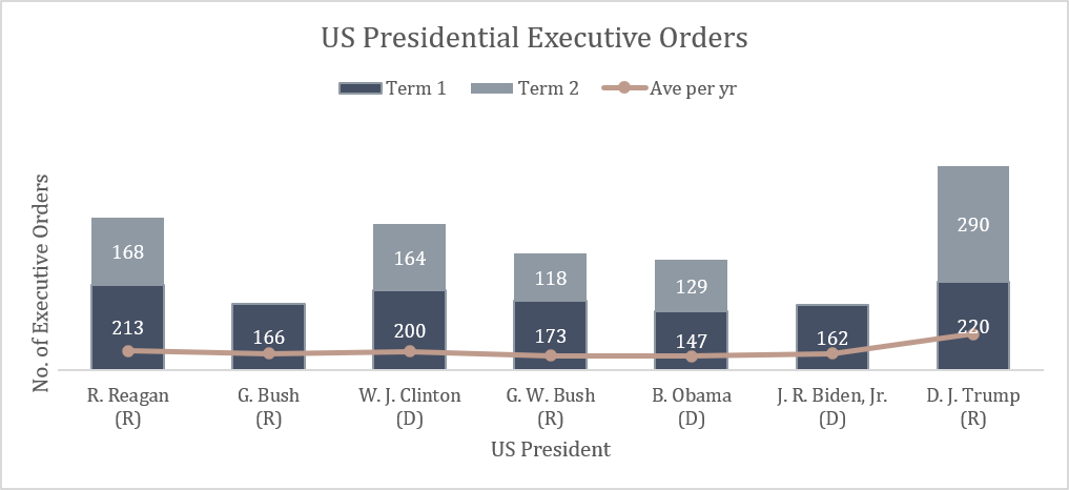
Note: D.J. Trump Term 2 Figures are up to date as of October 2026 with two years left of the presidential term.
In the run-up to the midterms, we tend to see increased volatility in stock markets as some investors choose to take profits, reduce risk, and sit on the sidelines until the results are known.
History shows that US stock markets have performed strongly in the twelve months following all midterm elections since 1950, with an average gain of around 16% to 18% for the S&P500 over that period on a total return basis (2). Regardless of which party has won, the clarity tends to improve investors’ confidence to buy back in, supporting a recovery in markets.
However, it is important not to read too much into this pattern. Historic data covers a relatively small sample, and there is also a risk of investor over-optimism, particularly with the expectation of a fourth quarter rally this year. What it does tell us is that the uncertainty leading up to an election is typically more unsettling for investors than the outcome itself, whatever that outcome may be. The question is whether Trump will escalate tensions with Iran after the midterm elections when he is no longer constrained by approval ratings. There is also a higher risk of a constitutional crisis this time as Trump could test the limits of his authority in his last two years in office.
UK autumn budget
Turning closer to home, for UK investors, the autumn budget may bring changes to taxation, spending and government borrowing plans that have very real implications for everyday life.
From a global investment perspective, however, the picture looks a little different. The UK represents around 3% of the global economy by output (3). For investors whose money is spread across world markets, what the UK Chancellor announces in any given budget has a relatively modest effect on the overall value of a diversified portfolio. Decisions taken in Washington, Beijing or Frankfurt tend to carry considerably more weight than those taken at the despatch box in Westminster.
That is not to say the budget is irrelevant. Significant changes to UK tax or spending policy can affect the domestic economic outlook, and we pay close attention to them. But for a globally diversified portfolio, domestic UK politics is just one input among many, and rarely the most important one.
When politics does matter: the bond market
One area where political decisions can receive a direct and powerful response from financial markets is the government bond market. A recent example in the UK came in September 2022, when then-Prime Minister Liz Truss and her Chancellor Kwasi Kwarteng announced a package of unfunded tax cuts in the ‘mini budget’. The announcement, which included £45 billion of tax reductions with no explanation of how they would be paid for, and no independent assessment from the Office for Budget Responsibility, deeply unsettled investors (4).
The reaction was swift and severe, with UK government bond yields spiking sharply as investors required much higher compensation for holding the debt of a government with significant unfunded spending liabilities. Five-year gilt yields recorded their largest single-day rise in over thirty years (5). The pound fell to a 37 year low against the US dollar (6). The Bank of England had to step in with an emergency support scheme worth up to £65 billion to prevent serious disruption in the pension fund sector, which holds large quantities of government bonds (7). Within weeks, the Chancellor was dismissed, the policies were reversed and the Prime Minister resigned. It was a stark illustration of the influence bond investors can have over government policy.
What this means for investors
So, what does all of this tell us about the relationship between politics and investment markets? Politics tends to spill over into markets when it has a profound effect on economic growth, borrowing costs or financial stability. Everything else such as the business of democracy, election campaigns, approval ratings, budget announcements, and parliamentary debates is background noise for global investors. In the meantime, our traffic light process focuses on capturing political risk when it does make an impact through Growth, Money, Momentum and Sentiment, rather than through a separate signal.